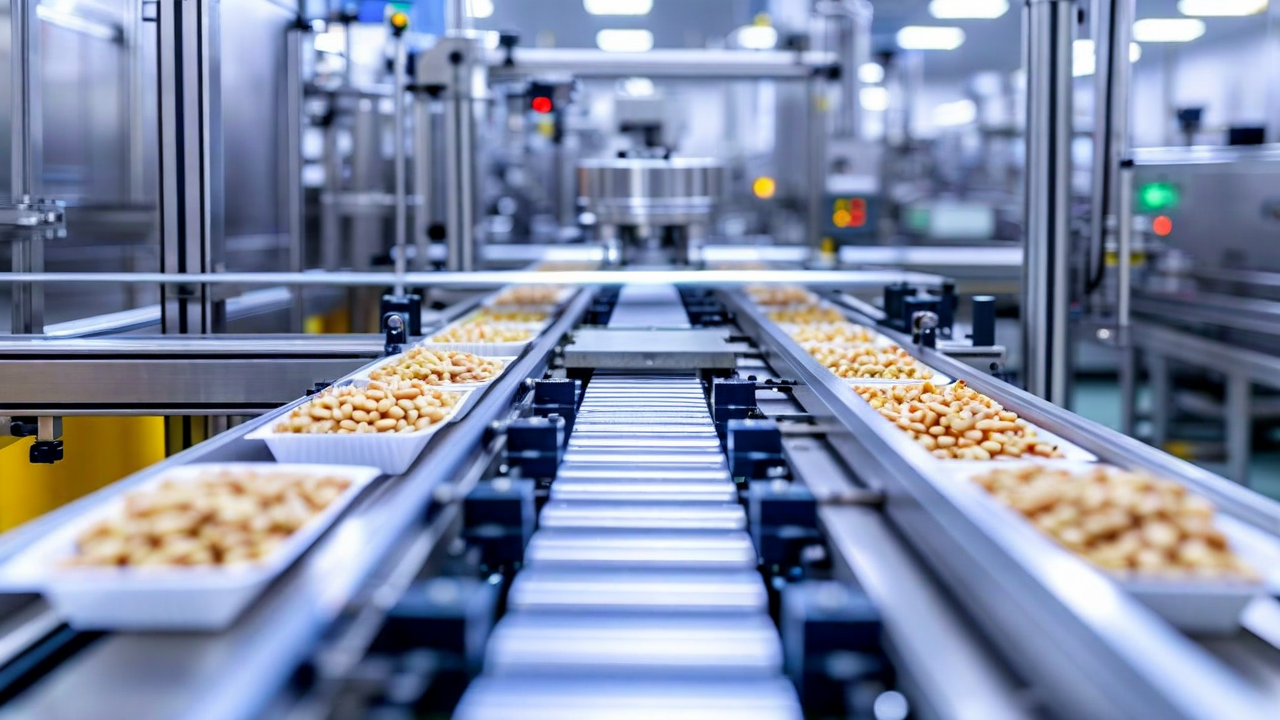
Food packaging plants run fast. A mid-size pouch filling line running at 400 units per minute produces 192,000 units per 8-hour shift. Putting a human inspector at the end of that line and expecting them to evaluate seal integrity, fill level, label placement, and date code legibility on every single unit is not a realistic quality strategy - it is wishful thinking dressed up as a process.
The industry has known this for years. Most lines use some combination of weight checks, seal pressure monitoring, and statistical sampling rather than 100% visual inspection. The problem is that defects missed by statistical sampling escape at a rate proportional to your defect frequency. At 0.3% defect rate on a 400 unit/minute line, sampling one in every 20 units means you are sending roughly 85 defective units per hour to packing. That becomes a consumer complaint problem and, potentially, a recall risk if any of those defects affect product integrity.
What a Packaging Line Actually Needs to Inspect
The inspection requirements on a typical flexible pouch line span four distinct categories. Seal integrity: are the heat seals fully formed with no channels or voids? Fill level: is the product within tolerance of the target fill weight, detectable as volume from a camera? Label compliance: is the label applied straight, fully adhered, and in the correct position? Date and lot code: is the inkjet or laser code readable and correctly formatted?
Each of these is a different inspection problem. Seal inspection requires detecting fine channels in a semi-transparent film under specific backlit or directional illumination. Fill level inspection requires detecting headspace geometry. Label placement is a registration check. Code inspection is optical character recognition against a template. A manual inspector does all of these simultaneously and inconsistently. An automated system runs separate detection algorithms tuned for each requirement, in parallel, at line speed.
Throughput Math
At 400 units per minute, a single camera station running at 30fps can inspect one unit per frame at speeds up to 30 units per second - 1,800 per minute. The camera is not the throughput constraint on any current packaging line. The constraint is usually conveyor spacing and the trigger timing for ejectors when a defect is detected.
Pneumatic ejectors typically have 80-120 millisecond actuation latency from trigger to mechanical rejection. At 400 units per minute, unit spacing needs to be at least 150mm to provide enough time between trigger and ejection without hitting adjacent units. If your line is running units more tightly spaced than that, a diverter arm or reject conveyor with longer travel distance is necessary rather than a direct pneumatic ejector.
The Consumer Complaint Economics
Consumer complaints cost more than most manufacturers account for when building the case for automated inspection. Direct cost per complaint - call center handling, potential replacement/refund, investigation - typically runs $15-$45 depending on the product. But complaints generate downstream effects: retailer chargebacks where they exist, elevated sampling in retail distribution audits, and in the worst cases, category buyer scrutiny that threatens shelf space.
One confectionery packager we worked with was averaging 340 consumer complaints per month related to packaging defects: partially sealed pouches, smeared date codes, and low-fill units that felt light to consumers. At $22 average direct cost per complaint, that was $7,480 per month in direct complaint costs. Not catastrophic in isolation - but when they traced the complaint rate back to their defect escape rate of 0.18%, the math pointed to roughly 1,100 defective units per shift reaching consumers.
Reducing defect escapes from 0.18% to 0.02% - a realistic target for automated inspection on their defect types - cuts consumer complaints by approximately 89%. At $22 per complaint, the annual savings from complaint reduction alone is $79,000.
Labor Cost Structure
Manual inspection labor on a three-shift operation at a typical food plant runs $18-$24 per hour all-in, including benefits and overhead allocation. A single inspection station with two inspectors per shift costs $108-$144 per day, $540-$720 per five-day week, roughly $28,000-$37,000 per year. That is one station.
Plants running multiple lines with end-of-line inspection on each one are spending $120,000-$200,000 per year on inspection labor for a process that still misses 15-20% of defects. The economics of automation look better when you account for the full labor spend, not just the headcount reduction on the first station.
Regulatory and Audit Considerations
FSMA requirements and major retailer codes of practice (Walmart, Kroger, Target) increasingly include CCP monitoring documentation expectations that are easier to satisfy with automated inspection records than with manual check sheet logs. An automated system generates timestamped per-unit inspection results by default. Every reject has an associated image, timestamp, and rejection reason. An audit that previously required pulling paper logs and reconstructing shift summaries takes minutes with digital records.
This is not the primary justification for automation - financial return is - but the documentation burden of manual inspection is real and gets less attention than it deserves in ROI calculations.
Building the Business Case
A complete business case needs five numbers: current defect escape rate, consumer complaint cost per unit, annual inspection labor cost, recall probability and estimated cost at current escape rate versus target rate, and expected system cost. Most food manufacturers have the first two in their quality records. The third is a straight labor calculation. The fourth requires some probability estimation that quality engineering can provide. The fifth is a vendor quote.
The cases we see fail are the ones that only count labor savings and ignore complaint costs, recall risk, and audit efficiency. A system that saves $40,000 in labor but costs $180,000 looks like a poor investment on a 4.5-year payback. The same system that also avoids $95,000 in annual complaint costs and reduces recall exposure looks like a 19-month payback with meaningful risk reduction on top.
Need help building the ROI case for your line?
We can work through the financials with you using your actual defect and complaint data. No commitment required.
Contact Our Team