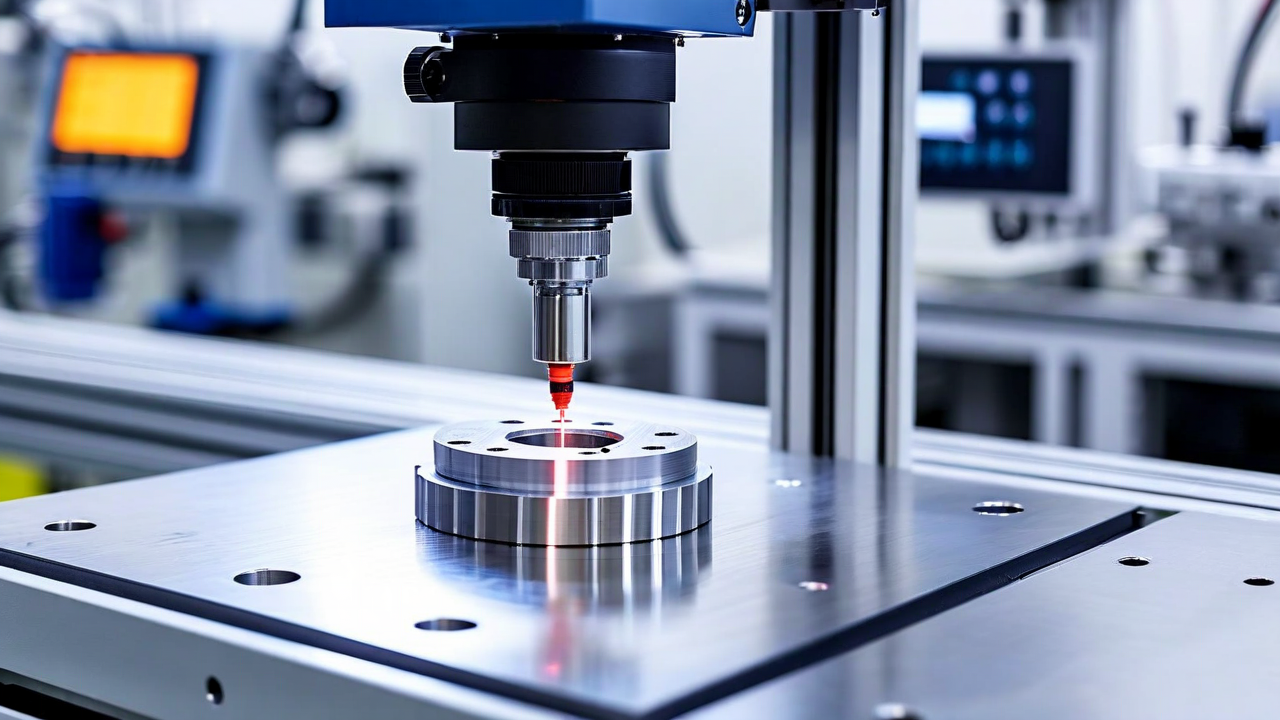
Coordinate measuring machines set the accuracy standard for dimensional inspection. A well-maintained CMM in a temperature-controlled environment routinely achieves measurement uncertainty in the 1-3 micrometer range, traceable to national standards. Machine vision systems measuring the same features are typically accurate to 10-50 micrometers under production conditions. On that basis alone, the comparison looks one-sided.
But a CMM measuring a machined bracket at the 3-minute cycle time common for medium-complexity parts inspects 20 parts per hour. A vision system measuring the same features in 0.4 seconds inspects 9,000 parts per hour. The accuracy advantage of the CMM is irrelevant if your tolerance stack is 0.1mm and your production rate is 2,000 parts per shift - no CMM-based strategy can provide 100% inspection coverage at that throughput.
Accuracy Requirements Determine Tool Selection
The first question is what tolerance your customer specification requires and what your actual process capability delivers. If your process capability Cpk is 1.4 on a 0.05mm tolerance - meaning your natural process variation consumes 71% of the tolerance band - you need measurement uncertainty well below 10 micrometers to reliably distinguish conforming from nonconforming parts near the tolerance boundaries. That points toward CMM for dimensional validation, potentially supplemented by statistical process control rather than 100% inspection.
If your tolerance is 0.2mm and your Cpk is 1.8 - common for stamped sheet metal features - machine vision measurement uncertainty of 20-30 micrometers is entirely adequate. The tolerance is wide enough that measurement error does not meaningfully affect accept/reject decisions. 100% inspection with vision is both feasible and provides better conformance assurance than statistical CMM sampling.
What Machine Vision Measures Well
Vision systems excel at 2D dimensional features on flat or near-planar surfaces visible within the camera field of view: hole diameter and position, edge-to-edge distances, flange width, slot dimensions, and overall part outline. These are features where the camera captures enough edge contrast to define boundaries to sub-pixel accuracy using edge detection algorithms.
Sub-pixel interpolation is what makes vision measurement meaningful at pixel sizes that would otherwise limit accuracy. A camera with 20-micron pixels can measure edge positions to 5-8 microns by fitting a gradient profile to the edge transition. This requires good illumination contrast at the measured edge - diffuse backlit illumination for flat features, or structured coaxial illumination for raised features. Measurement repeatability degrades rapidly when edge contrast is poor.
Height measurement - features out-of-plane relative to the camera - requires different approaches. Structured light, laser triangulation, or photometric stereo reconstruction can produce 3D surface maps from 2D cameras, but these add illumination complexity and processing overhead compared to simple 2D measurement. For straightforward height step measurement, laser triangulation sensors at $500-$3,000 each integrate cleanly into inline vision stations.
Where CMMs Remain Necessary
Complex 3D geometry - cylindrical bores, angular features, form tolerance measurement, true position in three dimensions - requires CMM or equivalent contact measurement. Vision systems looking at a drilled hole see the projected opening, not the bore diameter at depth or the bore cylindricity. A nominally 12mm bore with 0.3mm taper from entry to depth looks perfectly round from above. A CMM probing at three depths catches the taper; the vision system misses it entirely.
GD&T callouts involving datum references measured in multiple planes, perpendicularity, and angularity tolerances are generally beyond what 2D vision can validate without specialized structured light or CT scanning setups that are themselves approaching CMM cost. For these features, CMM remains the appropriate tool.
First article inspection, PPAP dimensional reports, and customer-mandated traceability submissions typically require CMM results with documented measurement uncertainty, gauge R&R studies, and traceable calibration records. Vision system data may supplement these but rarely replaces them for formal submissions.
Hybrid Inspection Workflows
The most effective quality programs use both tools in their appropriate roles. Vision systems provide 100% coverage on the high-volume features where visual accuracy is sufficient. CMMs perform periodic audits on the full feature set - typically 5-10 parts per shift or one full inspection per lot - to validate that the production process is stable and that no features outside the vision system's measurement scope have drifted.
In one machined component application, the vision system monitors eight 2D features per part at 100% coverage: two hole diameters, three edge distances, and three positional features. The CMM audits 12 features including all vision-inspected features plus four bore dimensions, two angularity callouts, and runout. The CMM audit takes 18 minutes per part and runs on 3 parts per shift. Any CMM result that disagrees with the vision system's pass/fail decision triggers immediate investigation - either the vision calibration has drifted, or the CMM is catching a feature type that the vision system cannot see.
Temperature and Fixturing
Vision measurement on a production floor faces challenges that CMM rooms avoid by design. Thermal expansion of the part and fixture between temperature fluctuations of 5-8 degrees centigrade can introduce dimensional variation of 0.01-0.04mm on aluminum parts. Parts measured warm from the machining process may be 0.015mm larger than the same parts measured after equalization to ambient temperature.
For tolerances below 0.1mm, part temperature at the vision station needs to be controlled or at minimum monitored with correction applied. For tolerances of 0.2mm and above, thermal effects are typically below 15% of the tolerance band and can be accepted as a systematic contribution to measurement uncertainty rather than corrected explicitly.
Evaluating vision measurement for your machined or stamped parts?
We can assess your tolerance requirements and feature geometry to determine where vision measurement is viable and where CMM coordination is needed.
Request a Technical Assessment